
An atmosphere of nervous excitement. Apparent is the chilled vapour coming from my fellow runners as they do the "starting line" wiggle on the starting line.
A rapid movement of the hips.
I'm at my local 5km community parkrun and I'm focused. Three, two, one...
Hold on. I have to sort my device. So does the runner alongside me.
The person behind us sighs. I refuse to go until… yes! Connection established, away I go.
During the scramble, it's difficult to find a arm without a fitness tracker on it. And it's not just us runners who rely on them.
It's a booming, multi-billion dollar industry. Brands like Apple Watch dominate, featuring an wide range of diverse devices to suit a variety of needs. According to how advanced the model you go for, costs can vary between a hundred pounds to a significant investment.
"It makes me crazy, it's impossible to stop checking."
"It comforts me… It feels like a friend supporting me."
"I wish it wouldn't say I've experienced a bad night's sleep."
A small sample of the comments I've received from like-minded tracker enthusiasts when I inquire what they think of theirs.
The Data Dilemma
My feelings on mine? Currently, frustrating. It's telling me my speed is wrong, causing me to question whether the overhead branches along my route are blocking my GPS connection.
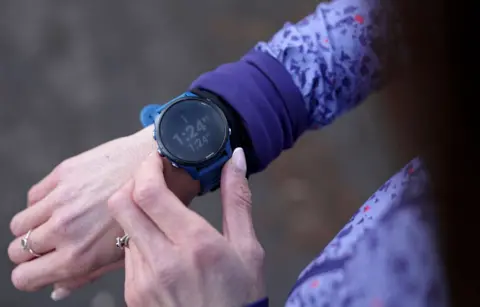
Countless individuals of us attach these compact gadgets onto our arms and wear them 24/7, apparently comfortable with the fact they're perpetually recording us.
A distant memory are the days when we depended on them solely to give us an idea of our pedometer reading. Currently, they can measure our sleep quality, heart rate, heart rate variability (HRV), our body battery.
It's a challenge to find a physical metric they don't track.
But do they do what they claim to do? And are the statistics we obsess over a true reflection of our actual health? Do they boost our mental and physical wellbeing, or do the avalanche of measurements and constant notifications just contribute to our sense of overwhelm?

A Love-Hate Relationship
"I find myself getting a quite obsessed with mine," a wearer confesses.
While she values how her device records her runs, she finds some of its other capabilities "daunting" at times - a feeling initially realised during a significant period.
Before she realised she could change its configuration, her smartwatch constantly alerted her she was not being active enough. Now, the watch keeps telling her she's had a poor sleep score.
"I have a six-month old, I don't need to be told my sleep was poor," she says. "I'm acutely aware all too clearly."
Is it not possible to just remove it?
"It's possible, I suppose, but I'm in this complicated dynamic with it," she says. "I love it for its workout tracking, I just wonder whether the additional features it can now do is perhaps too much for me."
Inside the Device
Every device of smartwatch has its own proprietary way of monitoring your vitals and interpreting your data, but the majority use sensors on the underside of the watch.
They usually shine tiny, coloured LED lights onto your arm which can monitor capillary action, recording your BPM. Higher-end devices detect changes in the bioimpedance that runs through the skin to assess your nervous system activity.
Expert Perspectives
A professor says that in general for smartwatches, it's a "fine balance" - while the continuously improving tech could actually save lives, "identifying issues before we feel unwell", it could also turn us device users into the "concerned but fine".
He points out that newer wearables can conduct tests like electrocardiograms (ECGs), which regularly monitor how stable the heart is. They can alert if someone is experiencing a heart arrhythmia, where there is abnormal electrical activity in the heart causing an arrhythmia.
This does not automatically signal someone is imminently going to suffer a cardiac event, but it can give an preliminary indication they might be more susceptible of a stroke in the long term.
But how to make sense of these figures is not straightforward. The expert worries that as more functions are added, people may not be able to fully comprehend their data.
"I have some doubts that being able to monitor so much data is such a positive development," he says.
A health researcher specialising in cardiology agrees. Her work into the effect of wearable tech on a cohort of cardiovascular patients suggested a significant portion of those who were given devices to monitor their condition experienced greater stress and were "had a higher tendency to use medical services".
She noted a vicious circle with her patients - they spotted a worrying figure on their watch. They felt anxious. Their BPM rose. They got more worried. They checked again, and their heart rate increased again.
"When people are presented with numbers about ourselves that we don't really understand then, of course, we are going to become concerned," the psychologist says. "We monitor, we re-check - it becomes a self-fulfilling prophecy."

